What Is Lease Abstraction? A Complete Guide for Commercial Real Estate Teams
By LeaseBoss · August 17, 2026 · 16 min read
Quick answer
Lease abstraction extracts the important business, financial, legal, and operational terms from a commercial lease into a structured lease abstract. Teams use that abstract to answer portfolio questions without reopening a long PDF every time.
Commercial leases are packed with critical information: rent schedules, renewal options, expense obligations, notice periods, operating expense provisions, insurance requirements, assignment rights, termination clauses, and dozens of other details.
The problem is that most of that information is buried inside documents that can easily run 50, 100, or even several hundred pages.
When you're managing one lease, finding an important clause might mean opening a PDF and searching for it.
When you're managing 50, 500, or 5,000 leases, that approach doesn't scale.
That's where lease abstraction comes in.
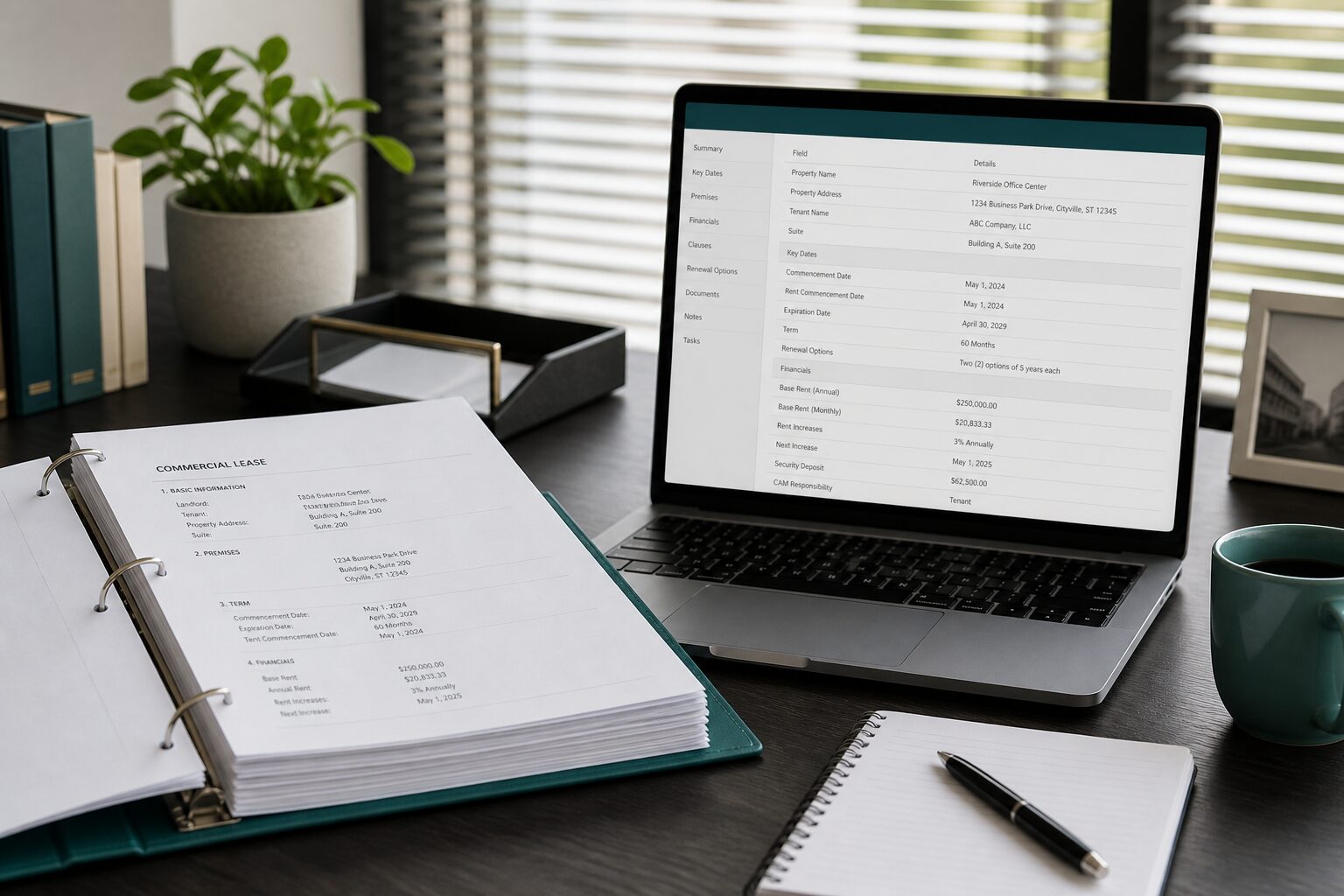
Lease abstraction turns complex lease documents into structured, searchable data that property managers, asset managers, lease administrators, accounting teams, and commercial real estate owners can actually use.
This guide explains what lease abstraction is, what information is typically extracted, how the process works, and how AI is changing the way commercial real estate teams manage lease data.
Once those terms are extracted, the next operational job is keeping deadlines alive across the portfolio. For that checklist, see The 12 Dates Every Lease Administrator Tracks.
What Is Lease Abstraction?
Lease abstraction is the process of reviewing a lease and extracting its most important business, financial, legal, and operational terms into a structured summary known as a lease abstract.
Instead of repeatedly searching through the original lease, teams can reference the abstract to quickly answer questions such as:
- When does the lease expire?
- What is the current base rent?
- When does rent increase?
- Does the tenant have a renewal option?
- How much notice is required to exercise that option?
- Who is responsible for repairs?
- How are operating expenses calculated?
- Is the tenant allowed to sublease the space?
- Does the tenant have an early termination right?
- What happens if the property is sold?
The original lease remains the authoritative legal document. The lease abstract simply makes the information inside it easier to find, organize, track, and act on.
What Information Is Included in a Lease Abstract?
There isn't one universal lease abstraction template.
The information captured depends on the property type, organization, lease structure, and reason the abstraction is being performed.
However, most commercial lease abstracts include several major categories of information.
Basic Lease Information
This section identifies the parties and property involved in the agreement.
Common fields include:
- Landlord name
- Tenant name
- Property name
- Property address
- Suite or unit number
- Premises description
- Rentable square footage
- Usable square footage
- Lease execution date
- Lease commencement date
- Rent commencement date
- Lease expiration date
- Lease term
These fields form the foundation of the lease record.
Base Rent and Rent Schedule
One of the most important parts of a lease abstraction is the rent schedule.
Commercial leases frequently include rent increases during the lease term. Those increases may be fixed amounts, percentage increases, CPI adjustments, or another negotiated structure.
A lease abstract may capture:
- Initial base rent
- Monthly rent
- Annual rent
- Rent per square foot
- Rent escalation dates
- Escalation percentages
- Free-rent periods
- Rent abatement
- Percentage rent provisions
- CPI adjustments
For leases with multiple rent periods, the abstract should clearly show when each new rental rate begins and ends.
Operating Expenses and Additional Rent
Base rent is often only one component of a tenant's total occupancy cost.
Depending on the lease structure, tenants may also be responsible for some or all of the property's operating expenses.
A lease abstraction may identify:
- Common area maintenance (CAM) obligations
- Real estate tax responsibilities
- Insurance expenses
- Utilities
- Management fees
- Administrative fees
- Expense caps
- Expense exclusions
- Base-year provisions
- Pro rata share
- Gross-up provisions
- Reconciliation requirements
These provisions can become particularly important when calculating recoveries or reviewing tenant charges.
Renewal and Extension Options
Renewal options are another critical area of lease abstraction.
A tenant might have the right to extend the lease for one or more additional terms, but exercising that right often requires notice months before the current lease expires.
An abstract should capture information such as:
- Number of renewal options
- Length of each renewal term
- Renewal notice deadline
- Earliest notice date
- Latest notice date
- Renewal rental rate
- Fair market value provisions
- Conditions required to exercise the option
Missing a renewal notice deadline can have significant financial consequences.
That's why lease administrators don't simply track expiration dates. They track the deadlines that occur before expiration.
Termination Rights
Some commercial leases allow the landlord or tenant to terminate the agreement before the scheduled expiration date.
An abstract may capture:
- Early termination date
- Required notice period
- Termination fee
- Conditions for exercising the right
- Required occupancy period
- Repayment obligations
These rights can dramatically affect the economics and risk profile of a lease.
Expansion, Contraction, and Purchase Rights
Commercial leases may also contain strategic rights affecting the tenant's space or the property itself.
Examples include:
- Expansion options
- Contraction rights
- Rights of first refusal (ROFR)
- Rights of first offer (ROFO)
- Purchase options
- Preferential leasing rights
These clauses can be easy to overlook because they may appear deep within the lease or in an amendment executed years later.
Security Deposits and Letters of Credit
Lease abstracts often document security arrangements, including:
- Cash security deposit
- Letter of credit amount
- Letter of credit expiration
- Reduction schedules
- Guarantor information
- Personal or corporate guarantees
For landlords managing large portfolios, tracking these obligations across hundreds of tenants can become a substantial administrative task.
Assignment and Subletting
Commercial tenants sometimes need to transfer their lease or sublease part of their premises.
The lease typically establishes rules governing these transactions.
An abstraction may capture:
- Assignment restrictions
- Subletting restrictions
- Landlord consent requirements
- Recapture rights
- Profit-sharing provisions
- Permitted transfers
- Change-of-control provisions
Understanding these clauses becomes particularly important during mergers, acquisitions, restructurings, and tenant relocations.
Maintenance and Repair Responsibilities
Responsibility for maintaining a commercial property isn't always straightforward.
Depending on the lease, the landlord or tenant may be responsible for:
- HVAC systems
- Plumbing
- Electrical systems
- Structural components
- Roof repairs
- Parking areas
- Common areas
- Interior maintenance
- Capital replacements
A well-structured lease abstract makes those responsibilities easier to identify without repeatedly reviewing the lease.
Insurance and Indemnification Requirements
Commercial leases frequently contain detailed insurance requirements.
An abstraction might capture:
- Required insurance policies
- Coverage limits
- Additional insured requirements
- Certificate requirements
- Indemnification obligations
- Waiver of subrogation provisions
These provisions are often particularly important for property management and risk management teams.
Important Lease Dates and Deadlines
One of the biggest benefits of lease abstraction is turning contractual language into actionable dates.
Important dates may include:
- Lease commencement
- Rent commencement
- Rent escalation
- Lease expiration
- Renewal notice deadline
- Termination notice deadline
- Expansion option deadline
- ROFR or ROFO deadlines
- Insurance certificate renewal
- Letter of credit expiration
- Tenant improvement deadlines
Once these dates have been extracted, they can be placed into a lease administration system or reminder workflow rather than relying on someone to remember to check the lease.
Why Is Lease Abstraction So Difficult?
At first glance, lease abstraction sounds simple: read the document and copy the important information.
In practice, commercial leases are complicated.
A single lease relationship might include the original lease plus:
- Amendments
- Addenda
- Exhibits
- Side letters
- Assignment agreements
- Commencement letters
- Expansion agreements
- Renewal agreements
And those documents don't always repeat the original terms.
An amendment executed five years later might replace a rent schedule, change the premises size, extend the expiration date, or modify a renewal option.
That means an accurate lease abstract must consider the entire lease document set, not simply the original agreement.
The Problem With Manual Lease Abstraction
Traditionally, lease abstraction has been a manual process.
Someone reads the lease, identifies the relevant clauses, and enters the information into a spreadsheet, property management platform, or lease administration system.
For a small number of leases, that may be manageable.
At portfolio scale, however, the process becomes expensive and time-consuming.
Manual abstraction also introduces several risks.
Human Error
Commercial leases contain dense language and interconnected provisions. Even experienced professionals can miss a date, misread a clause, or enter a number incorrectly.
Inconsistent Data
Different people may describe the same lease provision differently.
One person might enter:
Two five-year renewal options.
Another might enter:
2 x 5-year options.
A third might write:
Tenant may extend term twice.
All three may technically describe the same provision, but inconsistent formatting makes portfolio-level analysis more difficult.
Slow Portfolio Onboarding
Acquiring a property or portfolio can suddenly create the need to review dozens or hundreds of leases.
Manually abstracting every document can delay the point at which the acquiring team has reliable visibility into the portfolio.
Critical Dates Can Be Missed
Important deadlines may be buried inside hundreds of pages of lease documents.
A missed renewal, termination, or notice date can create real financial consequences.
How AI Is Changing Lease Abstraction
Modern AI systems can analyze lease documents and identify many of the provisions that previously required extensive manual review.
Instead of manually entering every lease field, a user can upload a lease and have software extract structured information such as:
- Lease term → January 1, 2026 – December 31, 2035
- Premises → Suite 400, approximately 18,250 rentable square feet
- Base rent → $42.00 per rentable square foot
- Annual escalation → 3%
- Renewal options → Two additional five-year terms
- Renewal notice → No earlier than 12 months and no later than 9 months before expiration
The goal isn't simply to summarize the document.
The real value comes from converting unstructured lease language into usable lease data.
AI Lease Abstraction vs. Traditional Lease Abstraction
Traditional lease abstraction typically requires someone to manually locate, interpret, and enter each important lease provision.
AI-assisted abstraction can dramatically accelerate the first stage of that process.
Instead of beginning with a blank abstraction template, a lease administrator can begin with a structured set of extracted terms and focus attention on review, exceptions, and higher-value analysis.
This can change the workflow from:
Read → Find → Interpret → Type → Verify
to:
Upload → Extract → Review → Verify
That difference becomes increasingly significant as portfolio size grows.
Does AI Eliminate the Need for Lease Review?
No.
Commercial leases are legal agreements, and important business decisions shouldn't rely blindly on automated extraction.
Ambiguous language, unusual clauses, poor document quality, conflicting amendments, and complex legal provisions can all require human judgment.
A better model is AI-assisted lease abstraction.
AI handles much of the repetitive work of locating and structuring information, while humans review important provisions and verify the results.
That combination can provide the speed of automation without treating AI output as a substitute for professional judgment.
What Makes a Good Lease Abstraction Platform?
A useful lease abstraction system should do more than generate a paragraph summarizing a lease.
Commercial real estate teams need structured information they can actually work with.
When evaluating lease abstraction software, consider whether it can:
- Extract structured lease fields
- Identify important dates
- Generate rent schedules
- Capture renewal and termination options
- Identify expense obligations
- Handle amendments and related documents
- Show where extracted information came from
- Allow users to review and correct extracted data
- Export lease information
- Maintain consistent fields across multiple leases
- Make portfolio-level lease information easier to search and analyze
The best system isn't necessarily the one that produces the longest lease summary.
It's the one that helps you find the information you need without reopening a 100-page lease every time you have a question.
Who Uses Lease Abstraction?
Lease abstraction is used across the commercial real estate industry.
Common users include:
Lease Administrators
Lease administrators track contractual obligations, critical dates, rent changes, options, and other lease events across a portfolio.
Property Managers
Property managers may reference lease abstracts when determining maintenance responsibilities, tenant obligations, expense recoveries, insurance requirements, and other operational issues.
Asset Managers
Asset managers use lease information to understand portfolio risk, upcoming expirations, tenant options, occupancy, and future cash flow.
Commercial Real Estate Owners
Owners need visibility into the financial and contractual obligations associated with their properties.
Accounting Teams
Lease data supports billing, recoveries, rent schedules, financial reporting, and other accounting workflows.
Acquisition Teams
During due diligence, buyers may need to understand dozens or hundreds of leases within a relatively short period of time.
Structured lease abstraction can make that review significantly easier.
Lease Abstraction Becomes More Valuable as Portfolios Grow
Imagine managing five commercial leases.
Opening the original documents whenever you have a question may be inconvenient, but it's probably manageable.
Now imagine managing 500.
One tenant has a renewal deadline approaching.
Another has a rent increase next month.
A third has an expansion option.
A fourth has an expiring letter of credit.
A fifth has an operating expense cap buried in an amendment signed seven years ago.
At that scale, the problem isn't simply storing leases.
The problem is turning those documents into information your team can act on.
That's ultimately what lease abstraction is designed to solve.
From Lease Documents to Lease Intelligence
Commercial real estate companies already possess enormous amounts of valuable information.
Much of it is trapped inside PDFs.
Lease abstraction is the first step toward making that information usable.
Once lease terms are converted into structured data, teams can begin answering much more useful questions:
- Which leases expire within the next 24 months?
- Which tenants have renewal options?
- Which rent increases occur next quarter?
- Which tenants have termination rights?
- Where do we have upcoming notice deadlines?
- Which leases contain unusual operating expense caps?
- How much contractual rent is scheduled across the portfolio?
The value isn't merely extracting information from documents.
It's creating visibility across the portfolio.
The Future of Lease Abstraction
Lease abstraction is moving away from static spreadsheets and one-time summaries toward continuously accessible lease intelligence.
Instead of asking:
Where does the lease say that?
commercial real estate teams should increasingly be able to ask:
Which leases in my portfolio contain this provision?
That's a much more powerful question.
AI makes it possible to move from manually searching individual documents toward structured, searchable lease portfolios where important dates, obligations, and risks can be surfaced automatically.
And for lease administrators, asset managers, and property owners, that means spending less time hunting through PDFs—and more time acting on the information inside them.
Frequently Asked Questions About Lease Abstraction
What is a lease abstract?
A lease abstract is a structured summary of the most important financial, legal, operational, and contractual terms contained in a lease.
What is commercial lease abstraction?
Commercial lease abstraction is the process of extracting important information from commercial real estate leases and organizing it into structured fields that can be reviewed, tracked, searched, and analyzed.
How long does it take to abstract a commercial lease?
The time required depends on the length and complexity of the lease, the number of amendments, the abstraction requirements, and whether the process is performed manually or with automation.
Can AI abstract commercial leases?
AI can identify and extract many common commercial lease provisions, including dates, rent schedules, renewal options, expense obligations, and other contractual terms. Important information should still be reviewed and verified before being relied upon for legal, financial, or operational decisions.
What is the difference between a lease abstract and a lease summary?
A lease summary may simply describe the major provisions of a lease in narrative form. A lease abstract typically organizes specific lease terms into standardized, structured fields, making the information easier to compare and manage across multiple leases.
Why do companies abstract leases?
Companies abstract leases so employees don't have to repeatedly search through lengthy lease documents to locate important information. Structured lease data also makes it easier to track deadlines, analyze portfolios, manage obligations, and identify potential risks.
Turn your leases into usable data
LeaseBoss helps commercial real estate teams turn complicated lease documents into structured lease data—so you spend less time hunting through PDFs and more time acting on the answers inside them.