Lease Abstraction Software: How It Works and What to Look For
By LeaseBoss · October 30, 2026 · 18 min read
Quick answer
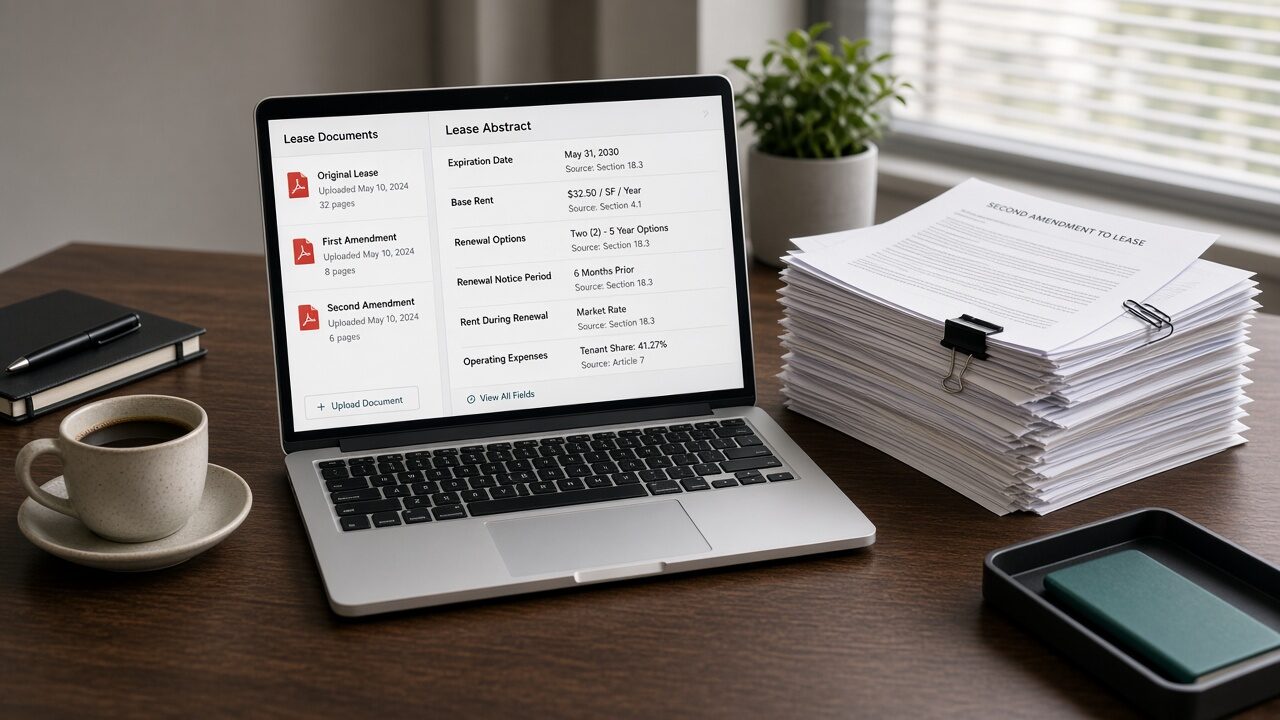
Lease abstraction software extracts important provisions and dates from commercial leases into structured fields you can review. Useful systems handle amendments, cite the source language, and make the results easy to verify—not just dump text from a PDF.
A commercial lease can be 50, 75, or well over 100 pages.
Then come the amendments.
Someone still has to figure out the rent, expiration date, renewal options, notice requirements, operating expenses, maintenance responsibilities, insurance requirements, and every other provision that matters after the lease is signed.
Traditionally, that meant sitting down with the lease and manually pulling information into a spreadsheet or lease management system.
Lease abstraction software is designed to speed up that process.
The basic idea is simple: upload the lease, let the software identify important provisions and dates, then review the results instead of starting from a blank spreadsheet.
The important part is what happens between upload and review.
Not all lease abstraction software works the same way, and simply extracting text from a PDF is not the same thing as understanding a lease.
Here is what the software actually does, where AI helps, and what to look for if you are evaluating a lease abstraction tool.
What Is Lease Abstraction Software?
Lease abstraction software turns information contained in a lease into structured data.
Instead of reading through an entire document every time you need to answer a question, you get a summarized view of the provisions that matter.
That might include:
- Landlord and tenant names
- Property and premises information
- Execution date
- Commencement date
- Rent commencement date
- Expiration date
- Base rent
- Rent increases
- Security deposit
- Operating expenses
- CAM provisions
- Renewal options
- Termination rights
- Assignment and subletting provisions
- Maintenance responsibilities
- Insurance requirements
- Notice periods
- Exclusives and restrictions
The exact fields depend on the lease and the software.
A good abstraction does more than produce a shorter version of the document. It organizes the information so someone can actually use it.
If you want the broader process first, see What Is Lease Abstraction?. For a filled-in example, see Commercial Lease Abstract Example + Free Template.
How Does Lease Abstraction Software Work?
Most modern lease abstraction software follows some version of the same process.
You upload a lease.
The software reads the document and identifies provisions that appear relevant.
Those provisions are converted into structured fields.
You review the results and correct anything that needs attention.
The finished abstract can then be stored, searched, exported, or entered into another system.
AI has made the extraction portion dramatically faster, but there is still a big difference between finding words in a document and correctly interpreting what those words mean.
Consider a lease that says:
Tenant shall have two options to extend the Term for five years each by providing Landlord written notice no earlier than twelve months and no later than nine months before expiration.
There are several pieces of useful information buried in that one sentence:
- Number of renewal options: 2
- Length of each option: 5 years
- Earliest notice: 12 months before expiration
- Latest notice: 9 months before expiration
Good lease abstraction software should recognize those as separate pieces of information rather than simply copying the paragraph into a summary.
What Can Lease Abstraction Software Extract?
The obvious answer is dates and dollars.
Those are important, but they are only part of a commercial lease.
A useful system should be able to identify information across several categories.
Basic lease information
This includes things such as:
- Landlord
- Tenant
- Property address
- Suite or premises
- Rentable square footage
- Lease type
- Execution date
- Commencement date
- Expiration date
These fields are usually straightforward, although even basic information can become complicated when amendments change the original terms.
For how execution dates can differ from other lease dates, see What Is a Lease Execution Date?.
Rent
Rent abstraction can include:
- Initial base rent
- Future rent increases
- Rent commencement date
- Free rent periods
- Percentage rent
- Additional rent
- Payment frequency
A five year lease with annual increases should not simply produce one rent number.
The useful output is a rent schedule showing what is owed and when it changes.
Critical dates
Commercial leases contain deadlines that are easy to miss if they live only inside the document.
Examples include:
- Expiration date
- Renewal notice deadlines
- Termination notice deadlines
- Expansion rights
- Contraction rights
- Purchase options
- Insurance renewal dates
- Rent escalation dates
A date becomes much more useful when it is tied to the event it controls.
For a full checklist, see The 12 Dates Every Lease Administrator Tracks.
Operating expenses and CAM
Expense provisions can get complicated quickly.
Lease abstraction software may need to identify:
- Tenant's proportionate share
- CAM obligations
- Expense caps
- Exclusions
- Audit rights
- Administrative fees
- Gross up provisions
- Base years
Pulling out a sentence that contains the phrase "operating expenses" is easy.
Understanding the actual tenant obligation is harder.
Options and rights
This can include:
- Renewal options
- Termination rights
- Expansion options
- Contraction options
- Rights of first refusal
- Rights of first offer
- Purchase options
The software should ideally capture not only whether the right exists, but also the conditions and notice periods attached to it.
Responsibilities
A commercial lease may divide responsibility for:
- HVAC
- Roof
- Structure
- Plumbing
- Electrical systems
- Utilities
- Common areas
- Repairs
- Replacement
These provisions are often scattered across multiple sections of the lease.
What About Lease Amendments?
This is one of the most important things to ask about any lease abstraction product.
A lease rarely stays exactly as it was originally signed.
Over time you might have:
- Original Lease
- First Amendment
- Second Amendment
- Extension Agreement
- Assignment
- Commencement Certificate
Now imagine the original lease says the term expires in 2027.
An amendment extends it to 2032.
A system that extracts the original expiration date without understanding the amendment is technically reading the document correctly while giving you the wrong current answer.
That is a major distinction.
Good lease abstraction software needs to consider the lease as a document set, not just a collection of unrelated PDFs.
The real question is:
What do the lease and all subsequent amendments say today?
That is much closer to the problem lease administrators actually need to solve.
AI Lease Abstraction vs. Traditional Lease Abstraction
Before modern AI tools, automated lease abstraction often relied heavily on templates, rules, keyword searches, and predefined document structures.
Those approaches can still be useful, particularly when documents are consistent.
AI makes it possible to handle much more variation in the way lease provisions are written.
One lease might say:
Tenant shall pay Base Rent beginning on the Rent Commencement Date.
Another might say:
Monthly Minimum Rent shall become due ninety days following delivery of the Premises.
A person can recognize that both sentences describe when rent begins.
Modern AI systems can often do the same thing.
That does not mean AI automatically understands every provision correctly.
Commercial leases are full of defined terms, cross references, exceptions, amendments, and language that changes meaning depending on another section of the document.
AI is extremely useful for getting to a first draft quickly.
It should not turn review into an afterthought.
Why Source References Matter
One of the most useful features in lease abstraction software is also one of the easiest to overlook.
Every important extracted field should tell you where the information came from.
Suppose the abstract says:
Renewal Option: One additional five year term
You should be able to see something like:
Source: Section 27.2, Page 64
That changes the workflow completely.
Without a source reference, someone reviewing the abstract has to search through the lease to verify the answer.
With a source reference, they can go directly to the provision.
This becomes even more important when the result looks unusual or when an amendment has changed the original language.
AI should help you find answers faster.
It should not force you to blindly trust them.
Lease Abstraction Software vs. Manual Abstraction
Manual abstraction still works.
For a company with five leases, a spreadsheet and careful review may be perfectly reasonable.
The problem appears as the portfolio grows.
Imagine manually reviewing:
- 10 leases
- Then 50 leases
- Then 250 leases
Now add amendments.
Then someone asks for every lease with an upcoming renewal option.
Or every location where the tenant is responsible for HVAC replacement.
Or every lease expiring in the next eighteen months.
The value of structured data increases quickly once you are managing more than a handful of agreements.
Software does not eliminate the need to understand leases.
It eliminates a lot of the repetitive work required to get the information organized in the first place.
Lease Abstraction Software vs. Outsourced Lease Abstraction Services
Another option is to send leases to a third party and have people abstract them for you.
That can make sense.
Outsourced lease abstraction services may be useful when:
- You have a large one time backlog
- You do not have internal staff available for review
- You need a highly customized abstract
- You want a third party responsible for the initial extraction
Software may make more sense when:
- New leases are added regularly
- Amendments arrive throughout the year
- You want immediate access to the results
- Your team wants to control the review process
- You do not want to send every new document out for abstraction
There is also a hybrid approach.
Software can create the first draft while a person verifies the important provisions.
For many teams, that is probably the most practical use of AI today.
What Should You Look for in Lease Abstraction Software?
A flashy upload screen is not enough.
If you are evaluating a system, there are several things worth testing.
Can it handle real commercial leases?
Do not test the software only with a clean ten page sample lease.
Upload something ugly.
Use a long lease with exhibits, scanned pages, tables, unusual formatting, and amendments.
That is much closer to the documents people deal with in the real world.
Does it understand amendments?
Ask what happens when an amendment changes a provision in the original lease.
Does the software simply abstract both documents?
Or does it help identify the current term?
That difference matters.
Does it provide source citations?
You should be able to verify important information without hunting through a hundred page document.
Does it extract structured data?
There is a big difference between this:
Renewal: Tenant has renewal rights. See Section 18.
and this:
- Renewal options: 2
- Option term: 5 years each
- Notice window: 9 to 12 months before expiration
- Source: Section 18.3
The second version is much more useful operationally.
Can you correct the results?
No extraction system is going to be perfect.
You should be able to review and edit the abstract.
Can you export the data?
Your information should not be trapped inside the application.
Depending on your workflow, you may want Excel, CSV, PDF, or integration with another system.
Does the software preserve the original documents?
An abstract is a reference tool.
The lease remains the underlying agreement.
You should always be able to get back to the original source document.
How Accurate Is AI Lease Abstraction?
There is no meaningful universal accuracy percentage for every commercial lease.
Accuracy depends on:
- Document quality
- Lease complexity
- Scan quality
- Provision type
- Amendments
- Tables
- Defined terms
- The AI model
- The extraction method
- What counts as "correct"
Extracting a tenant name from the first page is very different from interpreting an operating expense exclusion buried inside a long paragraph.
Be skeptical of anyone who reduces the entire problem to one accuracy number.
A better question is:
How easy is it to verify the result?
If the system gives you the extracted value, the source language, and the location in the document, review becomes much easier.
That is far more useful than asking someone to trust a mysterious confidence score.
Who Actually Needs Lease Abstraction Software?
Not everyone does.
If you own one building with three tenants and rarely need to look at the leases, a spreadsheet may be enough.
Lease abstraction software starts making more sense when you have:
- A growing lease portfolio
- Frequent amendments
- Multiple people referencing lease information
- Recurring reporting needs
- Renewal and notice deadlines
- Difficulty finding current lease terms
- Information scattered across PDFs and spreadsheets
It is particularly useful when the same questions keep coming up.
- When does this lease expire?
- When does rent increase?
- Do we have a renewal option?
- Who replaces the HVAC?
- Can the tenant assign the lease?
- What does the latest amendment change?
The point of lease abstraction software is to make those answers easier to find.
What Lease Abstraction Software Should Not Do
Software should not create false confidence.
A polished interface can make extracted information look more certain than it really is.
That is dangerous with legal documents.
A good system should make uncertainty visible.
It should make source language easy to inspect.
It should let a person correct the data.
And it should never pretend that an AI generated abstract replaces the lease itself or professional legal advice.
The goal is not to remove humans from lease administration.
The goal is to stop making humans repeatedly perform work that software can do in seconds.
How LeaseBoss Approaches Lease Abstraction
LeaseBoss was built around a simple problem.
The information you need is already inside the lease.
The hard part is finding it, organizing it, and keeping track of what changed when amendments are added.
With LeaseBoss, you upload commercial lease documents and turn them into structured information that is easier to review and reference.
That includes things such as:
- Key lease dates
- Rent information
- Options and rights
- Expense provisions
- Responsibilities
- Important clauses
- Document source references
The goal is not to hand you a black box summary and ask you to trust it.
The goal is to get you from a stack of lease documents to a usable first draft much faster, while still making it possible to verify what the lease actually says.
Lease Abstraction Software FAQ
What is lease abstraction software?
Lease abstraction software extracts important information from commercial leases and organizes it into structured fields that are easier to review, search, and manage.
Is lease abstraction software the same as lease management software?
Not necessarily. Lease abstraction software focuses on getting information out of lease documents. Lease management software may include broader functionality such as accounting, payments, portfolio management, workflows, reporting, or compliance. Some systems do both.
Can AI abstract a commercial lease?
Yes. Modern AI can identify and organize many common commercial lease provisions. Human review is still important, particularly for complex provisions, amendments, unusual language, and information with legal or financial consequences.
Can lease abstraction software read amendments?
Some systems can process amendments, but this is an important feature to verify. Simply extracting an amendment is different from understanding how that amendment changes the original lease.
Can lease abstraction software create a rent schedule?
It can if the software is designed to identify base rent, escalation dates, free rent periods, and other rent terms and convert them into structured data.
Does lease abstraction software replace legal review?
No. A lease abstract is a reference tool. It does not replace the lease itself or legal advice.
Is automated lease abstraction worth it?
That depends on the size and complexity of the portfolio. For a few simple leases, manual abstraction may be fine. As the number of leases and amendments grows, automation can significantly reduce the repetitive work involved in finding and organizing information.
The Bottom Line
Lease abstraction software is most useful when it does more than summarize documents.
It should turn lease language into information you can actually work with.
That means extracting the right data, handling amendments, preserving source references, making results easy to verify, and giving people a practical way to review the output.
AI has made the first part of lease abstraction much faster.
The best systems use that speed without pretending commercial leases suddenly became simple.
Because they did not.
They are still long, complicated documents filled with exceptions, cross references, amendments, dates, and obligations.
The difference is that you no longer have to start with a blank spreadsheet every time.
How LeaseBoss approaches lease abstraction
LeaseBoss helps turn commercial leases and amendments into structured, reviewable information so you can spend less time searching through documents and more time using the information inside them.